Hiding in Plain Sight · Goliath, Six Flags Over Georgia
The Green Light Lie
Why Six Flags shut down nine coasters after a fatal fall
If you've ever ridden a major roller coaster, you know the routine.
You pull down the lap bar until it clicks. A teenage ride worker walks down the line, gives the bar a quick tug, and slaps the side of the car. Up in the control booth, a green light pops up on a computer screen. The operator presses a button, and you're launched up a 200-foot hill at 70 miles per hour.
You sit there thinking that green light means one thing: you are safe.
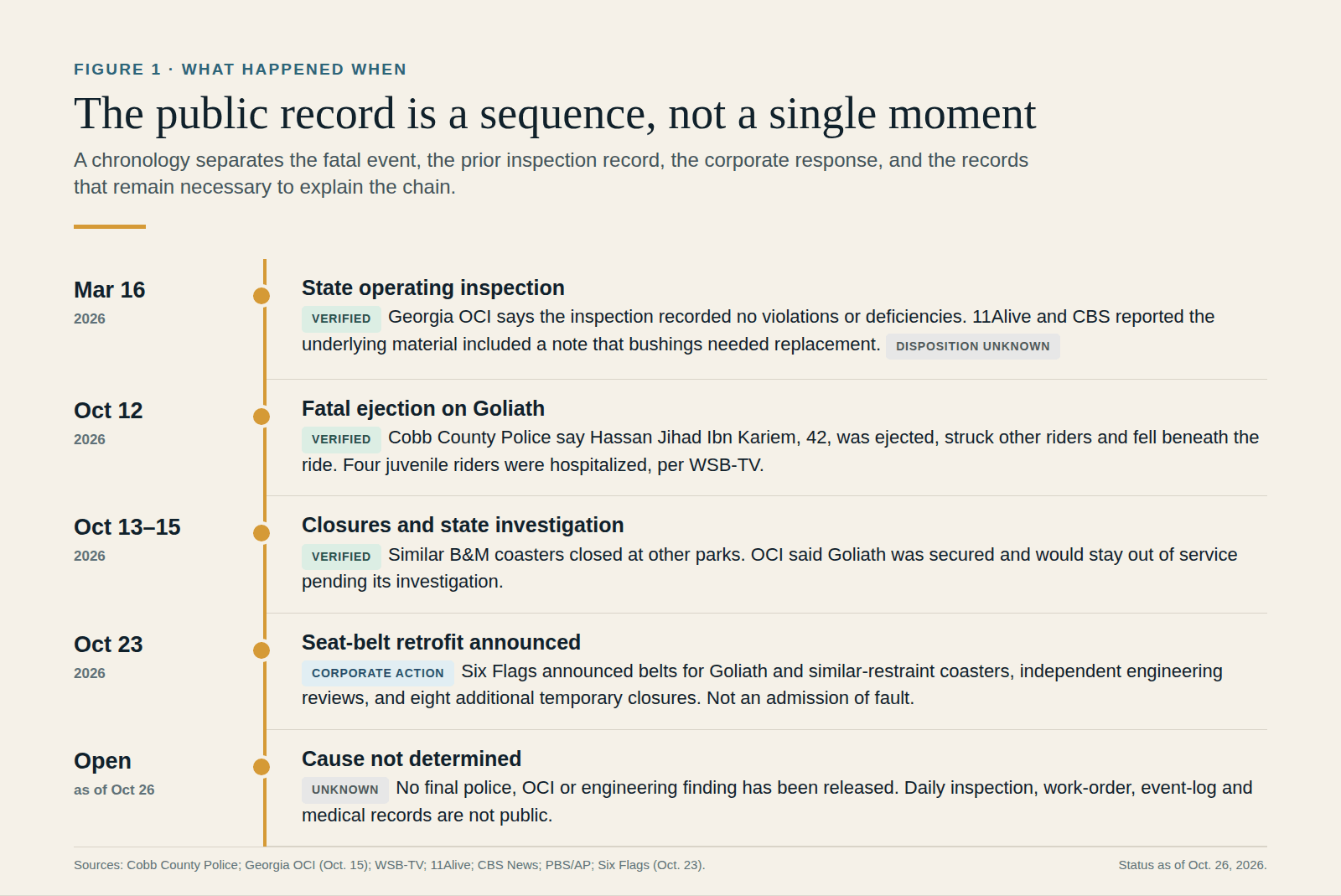
On October 12, 2026, on Goliath at Six Flags Over Georgia, 42-year-old Hassan Jihad Ibn Kariem trusted that same green light. Mid-ride, he was thrown from his seat and fell to his death.
Eleven days later, Six Flags announced seat belts for Goliath and similar coasters, leaving nine of its roller coasters across the U.S. and Canada offline until the belts are in.
The company framed it as routine care. "We are reinforcing safety precautions at our parks," CEO John Reilly said. Three days after the death, the state had already pointed out that Goliath passed its March inspection with no violations.
Let's cut through the corporate spin and break down what actually happened, in plain English.
The lie on the computer screen
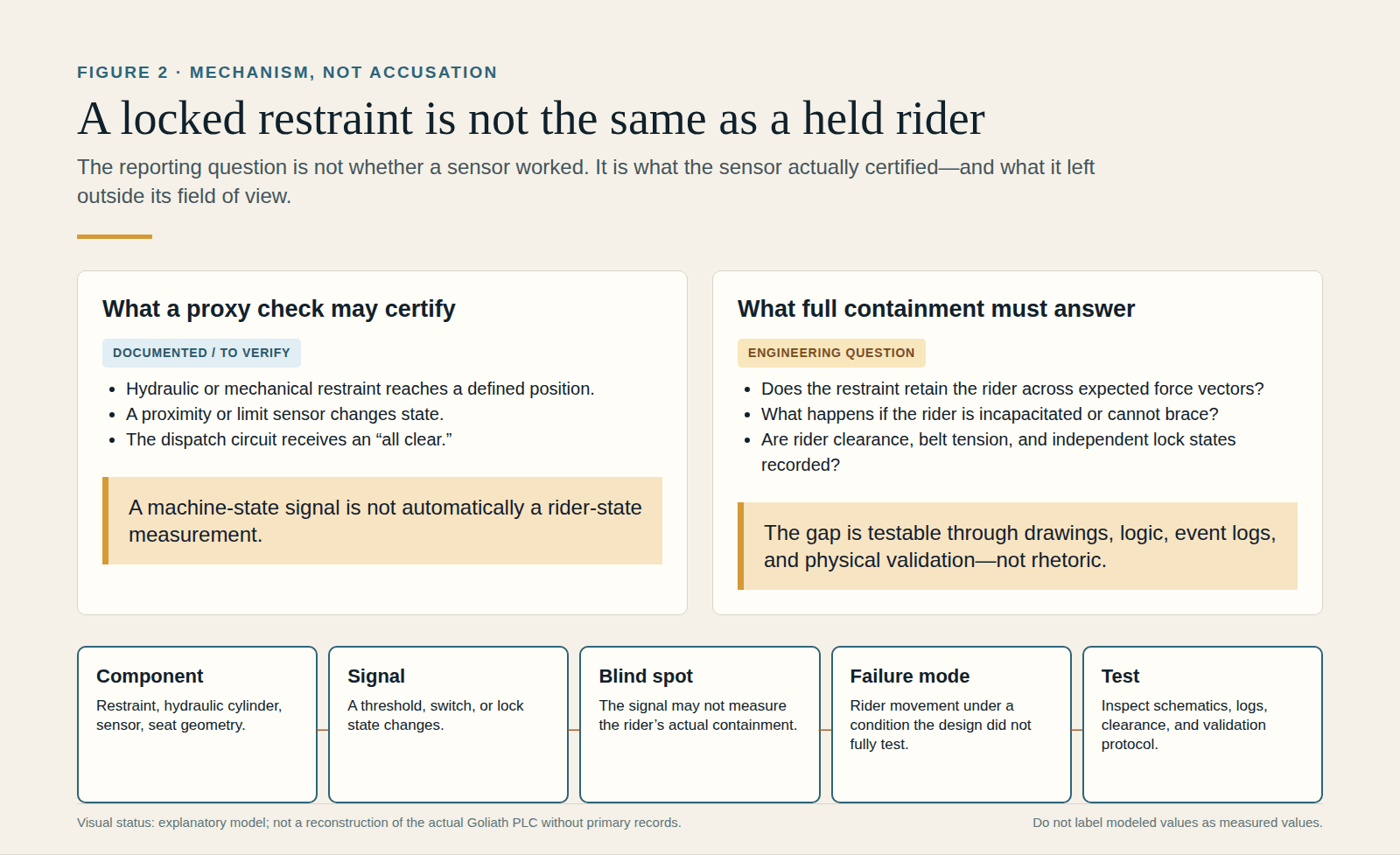
Here is the dirty secret the theme park industry doesn't want you to think about: the computer has no idea if you are actually locked in.
When the ride computer lights up green, it isn't checking your body. It isn't measuring how tight the bar is against your hips. It doesn't know if you're a 250-pound man, a thin teenager, or someone wearing a bulky jacket.
In a setup like Goliath's, the computer checks whether a metal rod inside a hydraulic cylinder has reached its locked position. If that piece of metal clicks past a little sensor switch, the computer says: "Good to go."
Think about your car door. If you close your seatbelt in the door latch, the car will tell you the door is shut. The sensor is happy. The latch is caught. But the door isn't actually sealed, and if you hit a bump at 70 mph, you're in trouble.
That's what happened on Goliath. The ride's computer gave a green light to a machine part, not a human being.
What happens when you pass out at -1G
Early speculation online pointed at rider size, as if Kariem was simply too big or didn't fit right.
His niece was sitting right next to him. According to her father, she says Kariem fainted or passed out on the ride.
When you're awake on a roller coaster, your body does a lot of work without you even noticing. When you drop, your legs push into the floor, your stomach muscles tighten, and your thighs press hard against the bar. You hold yourself in.
When you pass out, your body goes completely limp. You lose all muscle control.
Conscious rider: tense muscles and planted feet lock the body against the bar.
Unconscious rider: limp hips turn the bar into a seesaw. The body pivots forward and slides out.
Goliath uses a "clamshell" bar. It rests on top of your thighs, not across your belt line or between your legs. When you fly over a hill at 70 miles per hour, gravity doesn't just disappear. It goes into reverse. The ride pulls you up out of your seat with more than your own body weight in force.
Because Kariem was unconscious, his hips were free to move. There was no seat belt holding his waist down. The lap bar didn't act like a wall. It acted like the pivot point on a seesaw. The upward force lifted his hips, his upper body swung forward over the bar, and his legs slipped right out from underneath it.
Six Flags can say the restraint did its job, and on paper it may have. That's exactly the problem. The lap bar never broke. The lock never slipped. The system failed because it was built on a lazy assumption: that every rider will stay awake and hold themselves in.
The part the state flagged
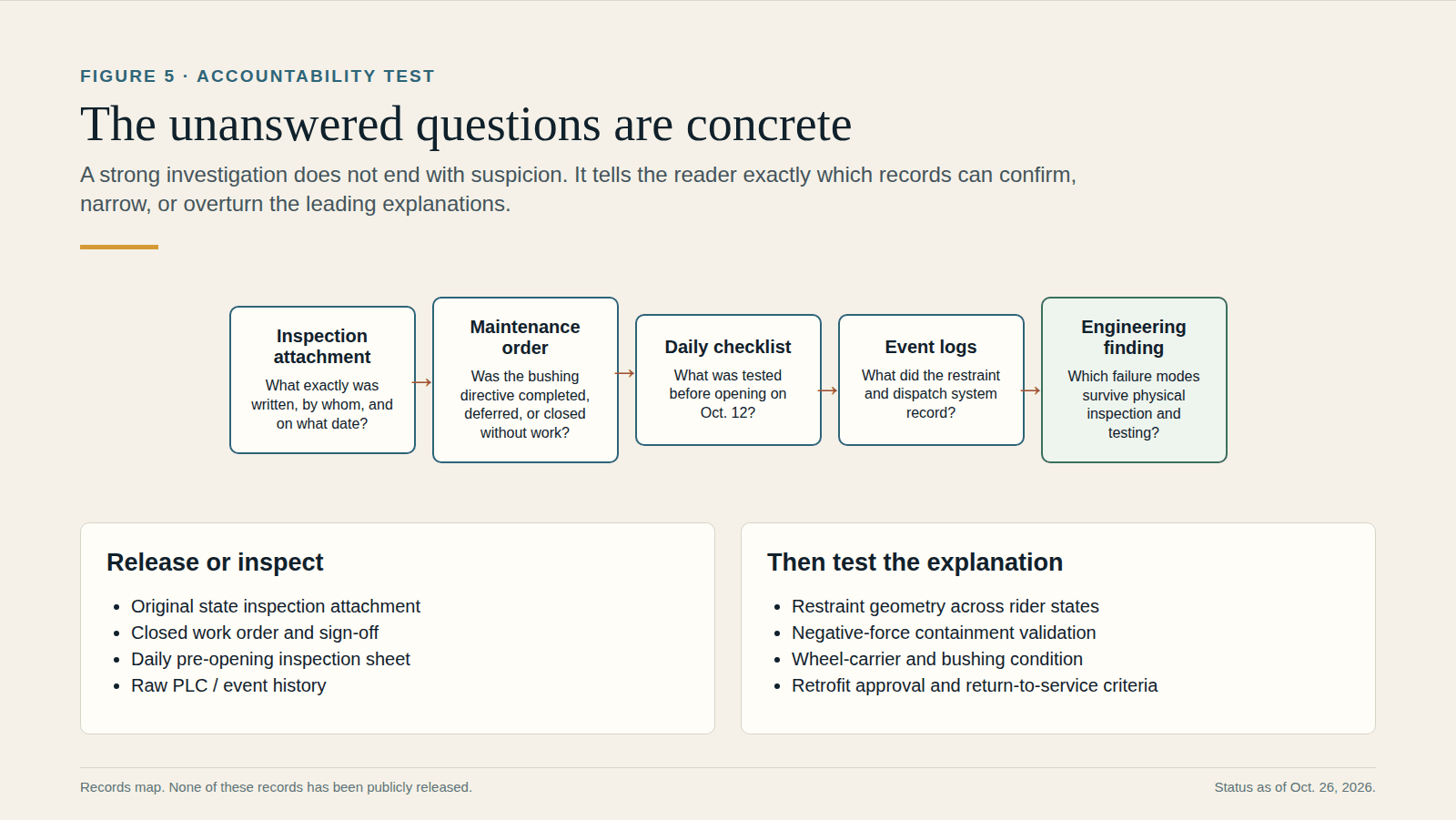
I covered the paper trail in The Surveillance Asymmetry. The short version: Goliath passed its March 16 state inspection with a handwritten note that its bushings needed replacing, and no one has shown that repair was signed off.
Here's why that note matters to this story. Bushings are heavy-duty cushions that sit between the steel coaster wheels and the train frame. They absorb track shock, keep the train from shaking violently, and stop metal-on-metal grinding.
When bushings wear down, a coaster train vibrates like a jackhammer. That vibration shakes the slick fiberglass seats, making it even easier for an unbraced, unconscious body to slide forward and lose whatever grip it had.
And two weeks after Kariem died, the signed daily inspection sheet for the morning of October 12 still hasn't surfaced.
The real reason nine coasters are parked
You don't shut down nine of your biggest money-makers right before Halloween weekend, the most profitable time of the year, to do a "routine upgrade."
You shut them down because you know the design has a fatal flaw.
By grounding rides in Georgia, Illinois, New Jersey, North Carolina, Ohio and Ontario to bolt in physical seat belts, Six Flags hasn't admitted fault, but the fix itself says what they won't:
A single lap bar without a seat belt is not enough to keep an incapacitated person inside a roller coaster.
If the lap bar were enough, those nine coasters would still be running today.
The same blind spot, in steel
Last week I wrote about how a park can know your face, your location and your snack order while you can't see whether the ride was checked this morning. Goliath's lap bar is that same blind spot built into the machine. The system measures what's easy to measure, a rod passing a switch, instead of what actually matters: whether the person in the seat is held in.
A fix from BOONE HOUSE
Exposing the failure without offering a fix leaves the job half-done. At BOONE HOUSE, we build tools for access and proof through BTEK and CACHE, and they apply directly where human safety is on the line. Fixing this doesn't require reinventing physics. It requires two things working together.
1. In the seat: the Dual-State Safety Interlock
Bolting a basic nylon belt into a fiberglass seat is nothing more than security theater if an attendant can still rush past it during a 45-second dispatch window.
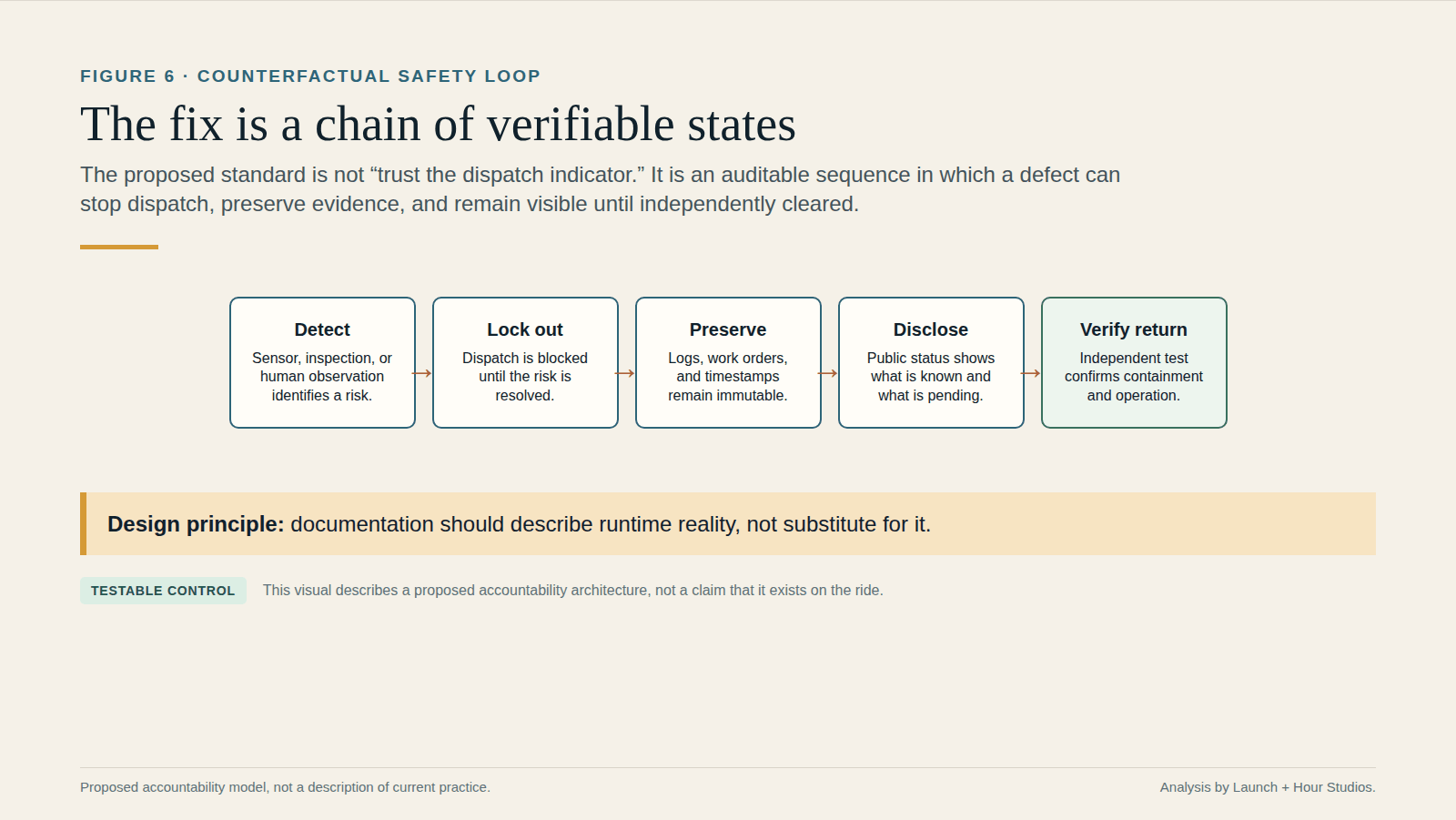
The seat must be built with two locks the computer checks together:
- The secondary pelvic belt has a built-in tension sensor (15 to 25 pounds of resistance) anchored to the seat floor.
- That sensor wires directly into the ride's safety computer alongside the hydraulic lap bar.
- The rule: if the belt isn't pulled tight across the rider's pelvic bone, the computer refuses to dispatch the train. No green light. No attendant override. The machine physically cannot launch until the human being is anchored.
2. At the entrance: proof before boarding
As I proposed in The Surveillance Asymmetry, every ride entrance should let a parent tap a phone and see this morning's inspection sign-off before getting in line. The seat interlock is the other half of that fix: proof outside the ride, and a hard stop inside it.
The official cause hasn't been released. But Hassan Kariem's death was no freak, unpredictable accident. It happened inside an industry that relies on a computer that checks machine parts instead of people, kept a ride running after a state inspector flagged worn parts, and hid behind a 1981 federal loophole until a fatal fall forced it to bolt down a basic seat belt.
It's time to end the green light lie. The technology to make rides transparent and fail-safe exists today. What's missing isn't the engineering. It's the corporate willingness to let the public see the truth.
Larry Boone is the founder of BOONE HOUSE, the parent company of BTEK, CACHE and Launch + Hour Studios. Hiding in Plain Sight looks at the safety records the public is told to trust but never gets to see.
Sources: Cobb County Police; Georgia Office of Commissioner of Insurance and Safety Fire (Oct. 15); WSB-TV on the March inspection; the family's account via Wide Open Country, citing WSB-TV; PBS NewsHour / AP on the seat-belt plan and closures (Oct. 23); 11Alive and CBS News. Status as of October 26, 2026.